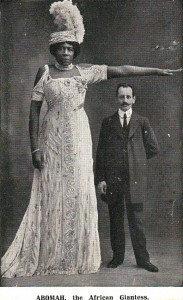
Abomah the African Giantess was an entertainer in 1900s Britain, for the format of the postcard is of that era. But I had not traced any of her appearances when completing my Black Edwardians: Black People in Britain 1901-1914 (1998). Later I came across a book that mentioned she was in Norwich in July or August 1914. Google “Abomah” and details of her years in Australia appear – Perth August 1904 en route to Melbourne; Hobart November 1904 and in May 1905; Opening at the Queens Hall, Pitt Street in Sydney on 15 April 1905, and mentioned in the Argus (Melbourne) in October 1906.A New Zealand book dealer’s site reproduces a ca.1902 English programme for Earl’s Court, London. Ray White read this page and alerted me to the New Zealand National Library’s site of newspapers (paperspast.natlib.govt.nz) which came up with 246 hits for “Abomah”. The Otago Witness 28 Sept 1904 named her as Ella Abomah and towards the southern end of South Island, the Southland Times of Invercargill reported her appearances there in December 1904. She was in North Island’s Wellington in February 1905, New Plymouth and Taranaki in March 1905, visiting Auckland. When in Nelson in December 1905 she was the “coloured giantess” born in Carolina. She was in Greymouth in January 1906, and spent Christmas 1907 in Wellington.It seems that Tit-Bits (London) 7 September 1900 said she was on her way to Liverpool. She seems to have been presented in Blackpool in 1901-1902, and was touring the English music halls in 1914. She was at Coney Island in 1917 then joined a freak display into 1925. Dismissing show business hype, she seems to have been born in South Carolina around 1862, had married and had children. There were several photographs of her, one as above but with ‘gientess’, and a biographical leaflet. Her activities in Britain remain very vague [see details added in August 2024, below].
Nine years after this page was created, in late 2018 a new source of information was supplied – https://kwekudee-tripdownmemorylane.blogspot.com/2012/09/mme-abomah-african-giantess-tallest.html.
In August 2024 I returned to research Abomah in Britain, and located the following mentions – very few reviews – one illustration as above – and a sketch of her apparently lighting a cigarette at the flame of a street gas lamp.
The Daily Sketch noted she was in France, which was copied by the South Devon Weekly Express of 12 May 1911, page 4. A year later she was appearing in Liverpool, at Reynolds’s Exhibition (Liverpool Echo, 20 June 1912, page 1). She was in Glossop, Derbyshire at the Electric Palace in March 1913 (Chronicle, Glossop 7 March 1913, page 4) and she was booked at the Picture Palace in Alfreton, Derbyshire in April 1913. The gas lamp sketch was used but there was no mention of Africa (Alfreton Journal, 4 April 1913, page 1). She appeared near Glasgow where the Airdrie and Coatbridge Advertiser announced “Hear her Sing the Latest Ragtime Songs” (14 June 1913, page 8). Heading south she was to appear at the Public Hall in Runcorn “next week” – and the Runcorn Weekly News of 18 July 1913 page 3 published the photograph (as above). Days later the Era listed her appearance at the Co-Operative Hall in Crewe (30 July 1913, page 11). She was the “dusky Giantess” appearing at the City Varieties in Leeds according to the Yorkshire Evening Post of 19 August 1913, page 3.
On the east coast the fishing and holiday town of Great Yarmouth was to see her in September 1913, appearing twice daily at the Yarmouth Hippodrome. The Yarmouth Independent reported that she had “just arrived from [a] tour round the world” (6 September 1913, page 8) and the Downham Market Gazette of 13 September 1913, page 6 said she was a “native of Africa”. The Hartlepool Northern Daily Mail of 30 October 1913 (page 1) said she was “the Dusky Rag-Time Giantess” due to make appearances for three more nights at the Palace Theatre.
The million-copy selling London Daily Mirror published her photograph holding hands with a small child – from the news reel film it seems – on 16 February 1914, page 10, and said that she had just arrived. Two days later she to appear at the Royal Hippodrome in Eastbourne on the south coast (Eastbourne Gazette, 18 February 1914, page 4). The Coventry Herald of 3 January 1914 (page 1) had reported her at the Hippodrome.
In April 1914 Abomah was appearing at the Palace theatre in Bradford (Leeds Mercury, 4 April 1914, page 4), and in May she appeared in Exeter (Exeter and Plymouth Gazette, 7 May 1914, page 2); in June she was in southern Wales, at the Cinema in Bridgend (Glamorgan Gazette, 19 June 1914, page 4), and in late-July at the Hippodrome in St Helens (St Helens Examiner, 18 July 1914, page 1). She moved to Scotland and appeared in the Theatre Royal, Edinburgh (Edinburgh Evening News, 28 July 1914 page 4). She was booked in at the Palace Theatre in Lincoln, and the Lincoln Leader of 8 August 1914 (page 3) published the sketch of her and the street lamp. The Halifax Daily Guardian (8 September 1914, page 3) described her a “a majestic figure, perfectly symmetrical”. Newspapers seldom described her act, but did report on her substantial diet, and her wish to find a husband. This led to an engagement with an Englishman, but one is inclined to dismiss this as a publicity stunt.
Abomah was seen by hundreds of Britons every day, and when city theatres had her appear twice daily the weekly total audiences would be at least twelve thousand. There are different photographic poses, suggesting that these were popular souvenirs.
“A woman the world couldnt look away from” published in http://www.kolumnmagazine.com was sent to me in late November 2025. It states that she died in Hawaii in 1928, having returned to the US when the world ware broke out.
See also pages 080 and 159 of this site.
Neil Parsons, Clicko: The Wild Dancing Bushman (University of Chicago Press, 2010) is worthwhile seeking out – a South African, he went on show in Britain and worked as a circus attraction in the USA in the 1920s and 1930s. He died in 1940.
LEAVE A REPLY IN THE BOX AT THE FOOT OF THE PAGE.
Many thanks to Ray White.
 Jeffrey Green. Historian