Claims made by entertainers are often dubious, and newspaper reports seldom struggle with seeking out the truth. In 1896 well into 1897 one Sergeant Simms toured major theatres with a group of black youngsters. They were billed as “Black Boys from the Bahamas” (South Wales Daily Post, 2 February 1897) when they were at the Empire in Swansea, having been “Sergeant Simms’s Negro Boys” when performing in Chatham in December 1896 (Era, 19 December 1896, p 24), the “Zouave troupe” when at the Tower in Blackpool (Era, 11 July 1896, p 16) and the “Columbian cadets” when at Brighton’s Alhambra (Era, 16 May 1896, p 19).
Back in June 1896 they (the Columbian Cadets) were on the same bill as “the Nassau Piccaninnies” appearing in Leeds and then in Sunderland (Era, 6 June 1896, p 19; Era, 20 June 1896, p 19). It is clear that one attraction was that the Simms troupe were youngsters – between those two jobs they were billed as “piccaninnies” when at the Alhambra in Hull (Era, 13 June 1896, p 21).
As Nassau is in the Bahamas, the so-called Nassau Piccaninnies may well have been the younger and smallest members of the group. Or the same lads. There were twelve on stage when they were performing in Bristol – and in March 1897 they both were linked to Simms in the Era of 20 March 1897) page 20) which reported “Sergeant Simms’s Nassau Piccaninnies and Columbian Cadets” were appearing at the Palace Theatre of Varieties in Manchester.
Simms’s group presented “a smart turn of drill and bayonet exercises, concluding with a military entr’acte” at the Empire in Swansea (February 1897), a continuation of the “military drill” reported at the Palace in Bristol (May 1896) and their “military act” at the Empire in Belfast in July 1896.
William Henry Simms was ‘born in Nassau, Bahamas, c. 1850, “formerly an officer in the 6th Mass. regime,’
and had toured Britain before 1884 with “Haverly’s troupe, but stayed on in England after Callender’s troupe returned to the States and began to work at first as a solo act, ‘the Wonderful Black Zouave, in his marvellous feats with Rifle and Bayonet’.”
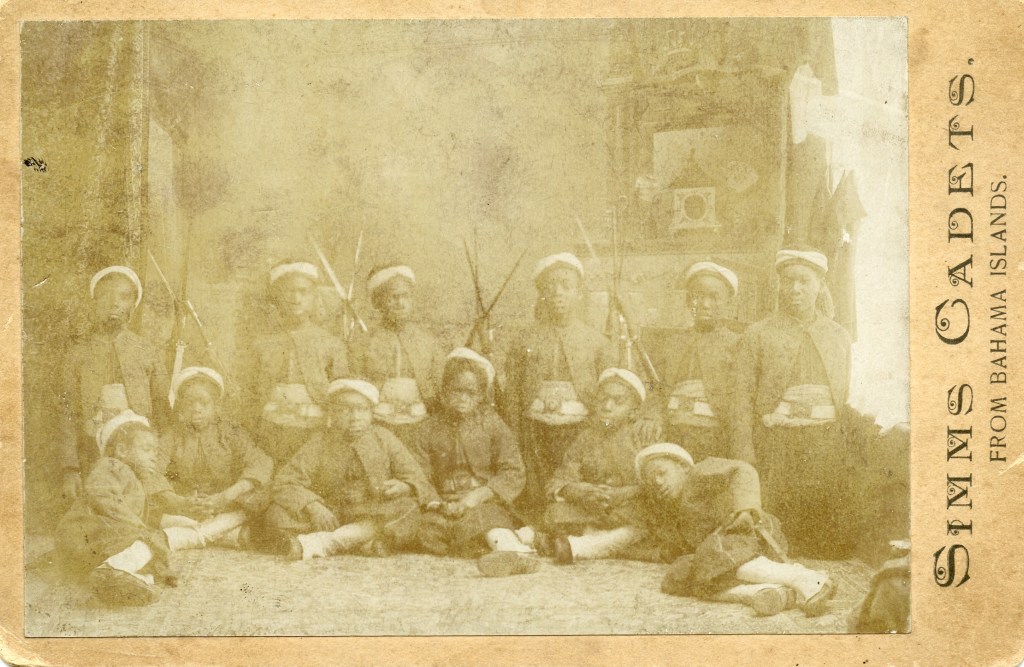
courtesy Rainer Lotz
 Jeffrey Green. Historian