By Rainer E Lotz, Bonn, Germany
This article was given as a talk in Charleston, South Carolina, in 2007. The use of US passport applications as a historical source, as initiated by Rainer Lotz, reveals black Americans in a wide range of activities in widespread towns in continental Europe. A similar search – the documents are filed in consul/embassy locations – in British and Irish consulate files may well provide fresh insights and new information.
The most prominent Americans of African descent in Europe in the years before the First World War were active as entertainers. Most Americans know about Josephine Baker, the girl from St Louis who conquered Paris from 1925. Charlestonians will be aware that musicians of the Jenkins Orphanage of this city played in London, England, in 1895, 1914, and 1929.
Race leaders Booker T. Washington and W. E. B. Du Bois visited Europe – the latter studied at the University of Berlin in the 1890s. Composer Will Marion Cook studied in Germany too, as did Booker T. Washington’s daughter Portia (Du Bois’s daughter studied in England).
The European activities of a handful of lesser known individuals from South Carolina, especially Charleston have been revealed by that most prosaic of items – the passport.
Anyone who travels abroad these days carries a passport, but a century ago they were not at all normal. ‘By the beginning of the twentieth century,’ wrote Martin Lloyd in his The Passport: The History of Man’s Most Travelled Document (Stroud, England: Sutton Publishing, 2005), ‘passports were in most cases a facility or a politeness, not a requirement. Only Bulgaria, Romania, Russia and Turkey obliged every foreigner to obtain a passport’. Russia a century ago included Poland and Finland; Turkey ruled most the Balkans. So if one travelled east of Germany, Sweden, or Hungary a passport was needed.
In the National Archives, Washington D.C. I have located the files of the following, which could in some cases be corroborated by an examination of European theatrical journals:
Thomas James, born in Charleston on January 24, 1871 who was in Vienna (Austria) in 1906 requesting a replacement for his passport that had been burned. ‘Complexion: colored’. James, whose permanent residence was Charleston, also declared his occupation as ‘artist’ by which he surely meant working in the entertainment business.
Henry Norris Jackson was also born in Charleston, on August 1, 1871. A passport was issued to him in Copenhagen (Denmark) in 1899. He returned to the US, and left again in mid-1903. In December 1904 he was in Berlin, requesting a passport to replace the passport he had left in Sweden. His occupation was ‘singer’ and his permanent residence: Brooklyn, New York. He was reported in Swedish newspapers in 1905, and 1921 as a concert singer (Damernas Musikblad no. 18 1905; Dagens Nyheter 1921-06-26).
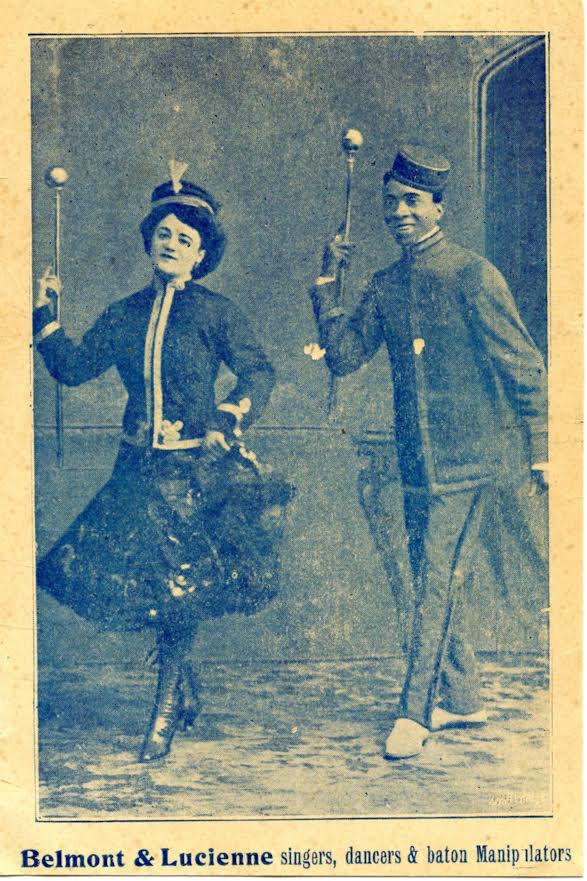
William Browny Belmont left his home country in 1903. In 1907, working as an artist in Constantinople (now: Istanbul) he identified himself to the American consul as a Charlestonian born on December 7, 1879. The consul noted his complexion as black. On a postcard he signed in Sofia, Bulgaria, in December 1911 he is described as a baton manipulator and a postcard has been located of ‘Belmont & Lucienne, singers, dancers, and baton manipulators’.
Three Charlestonians, five countries (Austria, Denmark, Sweden, Germany and Turkey).
William James was born in Washington D.C. on April 9, 1872, but gave Charleston SC as his permanent residence when applying for his passport in Chemnitz (Germany) in September 1901. In April the previous year James, occupation ‘artist’, had received a passport from the consulate in Leipzig (Germany), when his US home was Washington DC. He lost the document in Gotha in Germany following an accident when working as an actor. He also worked as a laborer – James was illiterate.
Arthur Butler was born in Charleston on February 18, 1875. As European armies prepared for war in the summer of 1914 Butler asked for a passport at the US embassy in Berlin. His occupation? ‘Chauffeur’.
Edward Williams was also born in Charleston, he remembered his birth was in May 1876. In 1901, in the then Russian capital city St. Petersburg, he applied for an emergency passport. His identity was confirmed by James H. Bacon, born in Savannah, Georgia, on August 22, 1877, who applied for his own passport on the same date. Bacon in turn certified the identity of Williams. The two southerners were both sailors and had left New York for Europe together a few months earlier, in May 1901, presumably aboard the same ship.
Some other non-entertainer South Carolinians located in the pre-First World War applications in the Passport Office include William Chisholm, was born on St Helena Island on December 15, 1866. He and his family can be traced in the June 1870 US census: Romeo Chisholm, 41, Farmer; Tenah, 33. Margaret, 11, laborer; John, 4, in home; William, 2, in home; and James, 1, in home. Working as a waiter in Hamburg (Germany) William had been away from South Carolina since 1889. His passport details were recorded in Berlin in 1894 and in Hamburg in 1896.
George Corten, born in Charleston on June 4, 1869, was in Hamburg in 1897 and applied for an emergency passport. He was illiterate – his occupation was noted as ‘docker’.
Birt Edwards was born in Rockhill, South Carolina on January 1, 1880. He left there in 1901. In May 1902 and again in September 1902 Edwards applied for his US passport in St Petersburg (Russia), the State Department files offer no explanation why two passports had to be issued within a few months’ time. Edwards was also illiterate which makes one wonder how he earned his living as a ‘messenger’.
Pervis Edwards was also illiterate, and claimed to have been born at Aiken, SC, on January 1, 1879. He left for Europe in 1898. In July 1911 he applied for his passport in Paris (France). Occupation: ‘jockey’. His work entertained thousands at the racetracks of course.
It was in 1911 that Peter C. Johnson left America for Europe. Born in Charleston on February 16, 1890, Johnson applied for his passport in Norway in 1913. ‘Stage artist’ Johnson obtained a fresh passport in Berlin in June 1914, as he was heading for Russia. Richard Davis and Walter Shaw also applied for passports on that date so perhaps Johnson worked on stage in a trio act.
Crossing the state line into Georgia we see Emma Elizabeth Harris, an ‘artist’ born in Augusta on October 9, 1875, applied for her passport in Berlin in 1903 as she was travelling to Russia ‘and elsewhere’. She lived in Brooklyn (NY). Her witness (who obtained a fresh passport that same day) was William Ceado born in 1863 in Iowa and, when he returned to New York in 1909, was associated with the Barnum and Bailey enterprise in Chicago. In 1915 in Moscow, Emma Harris had an acting role in the movie Satan’s Woman.
Born in Savannah were Wiley Sanders, an illiterate labourer who was in Germany in 1896 aged 23 (born August 21, 1873), and James Francis a carpenter who, at age 22 (born October 25,1880), had spent three months in Europe when he applied for his passport in Königsberg in eastern Germany (now Russia) in 1902. Francis had no witnesses. ‘Complexion: negro’.
And Harry Gravely Davenport born in Savanah on October 11, 1875, had been in Europe since 1895, when, occupation: ‘singer’ he applied for a new passport in Berlin in July 1900 as he too was off to Russia.
Joseph Carter was also born in Savannah around 1869 (on different occasions he claimed 1867 or 1870 as the year of birth). He left America in 1890, was in Berlin in 1892, in Rotterdam (Holland) in 1896, and back in Germany in 1897. He worked with his white wife Cecile (possibly English) in a stage act ‘Black and White’. He was a superb guitarist. They toured Germany into 1901, and have been located in Belgium and Italy too. Traced into 1905.
Nearer Charleston at Beaufort is the birthplace of Edward Claude Thompson (born 26 December, 1878, complexion ‘dark’). Thompson was a female impersonator – today one would say a drag artist. From 1901 to 1911 he played towns in Norway, Germany, Sweden, Russia, France, Hungary and Austria. Known as ‘the Creole Patti’ or ‘Modjesko’, Thompson’s four passport applications survive, as do details of his arrivals at Ellis Island. In Sweden he – or should it be she? – was billed as being Australian. Kees van Dongen painted him in oil in 1908.
Lucy Jackson, whose maiden name remains unknown, was born in Charleston on October 10, 1867, and left America in 1896 as a member of the ‘Black America Company’. 25 in number (of 18 with identified birth places, we also have two from North Carolina, nine from Kentucky, and one each from Alabama, Ohio, New Jersey, Virginia, New York and Maryland) by 1899 she was a solo act based in Berlin. She was in Poland in 1901, Finland in 1904, Austria and Hungary in 1905 and then worked with William H. Smith (born in Philadelphia) as ‘Smith and Bella Jackson’. Mrs Jackson was a singer, and danced. In 1910 they were in southern Germany, in 1911 in Istanbul (Turkey), then Athens (Greece) and Egypt in north Africa. By the time they were back in Munich (south Germany) in 1913 they were billed as coming from the Indian Ocean island of Madagascar. Last located in Hamburg in 1913 – seventeen years after she had left America.
(There may have been three women all named Lucy Jackson. The Charlestonian was classified as illiterate. The Hamburg, 1903, application had a passport issued in Russia in January 1899 and a mature longhand signature. She stated she had been born in Montreal (Canada) in 1877 and lived in New York City. Ten years later the Lucy Jackson who obtained a new passport in Hamburg was apparently born in New York City in November 1878 and had been issued with a passport in Vienna in December 1910. This signature is an immature longhand. All three had left the US in 1896.)
Another Charlestonian in pre-World War One Europe is Joseph Beckles. Born on December 12, 1875, he was in Europe in the late 1890s. His passport application in Berlin in 1897 was made because he was going to Russia. Occupation ‘actor’, permanent residence ‘Charleston’. Five years later, again at the US embassy in Berlin, Beckles said he was a ‘comedian’. The third secretary of the embassy noted ‘warned’ on the file. Three years later in 1904 Beckles was working as a comedian in Denmark and Norway. In 1906 he was the ‘American Negro Comedian’ in Czarnowitz (then in Austria and now in Ukraine) and in 1907 he was dancing the cakewalk in Budapest (Hungary) in a theatre where Smith and Bella Jackson appeared, too. Last traced through theatrical reviews in northern Germany in May 1908 where he was billed as ‘Happy Joe Beckles’.
These twenty men and women (eight born in Charleston) are indeed a mixed bunch. Eight had no obvious role in entertainment but the chances are that they had worked on the stage in minstrel, Uncle Tom’s Cabin, dance, slavery melodramas, in circus shows, as wrestlers and in other presentations. But they had to describe their current employment to the embassy staff.
What route had William Chisholm followed from St Helena island to work as a waiter in Hamburg? He had to have understood German in that role. Why did Lucy Jackson sing a parody of Tyrolean yodelling in Germany in 1905? What did ‘Happy Joe Beckles’ do in Russia in 1898? What work did the illiterate Thomas James secure in Austria in early 1906?
What is certain is that black migrants from this region (South Carolina and eastern Georgia) moved to Europe in the late nineteenth century. They worked in visible occupations – notably stage entertainments but also as a chauffeur, a jockey, and a waiter. They survived, some travelled widely, very widely, and many made return visits.
The black American presence in continental Europe did not start with Josephine Baker – and the sight of mature black women on stage was far from a rarity in many European cities and towns from the 1890s. That Charleston, South Carolina, was the birthplace and home for some of these overlooked people shows that, as in so many aspects of the history of Charleston, this historic American city needs to re-examine the evidence to learn more about its African-descent population.
That James Weldon Johnson, years before his Black Manhattan book and work for the NAACP in the 1920s, spoke with a theatre manager – a South Carolinian black – in Belgium in 1905 suggests that we all have something to learn.
Bonn, Germany, 23 June, 2007
 Jeffrey Green. Historian